Living Software Catalog
A Software Catalog That Writes
and Maintains Itself
A complete, queryable record of every service, API, cloud resource, owner, and business capability in your system, built directly from your codebase. No entries to write. No entries that go stale.
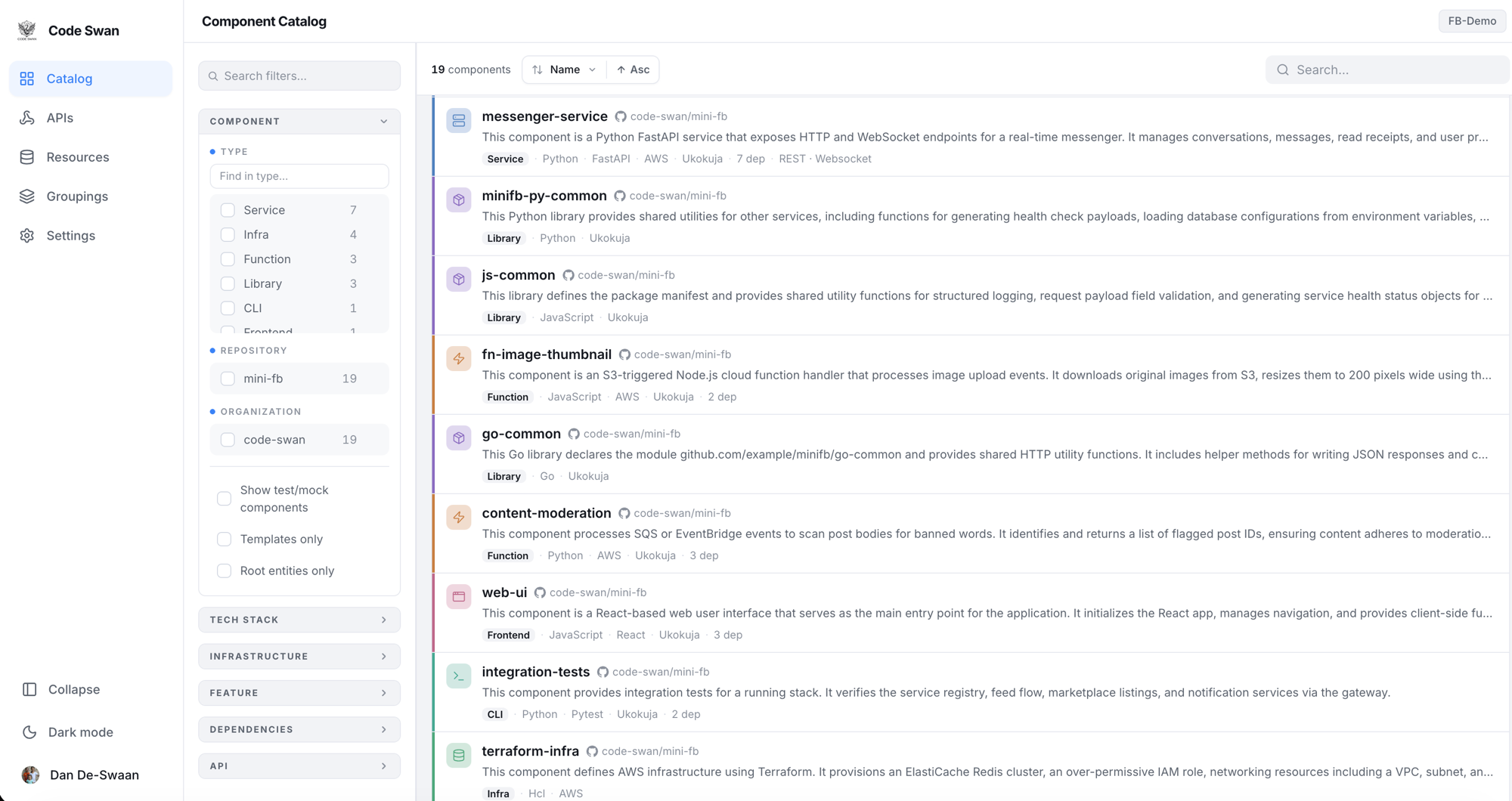
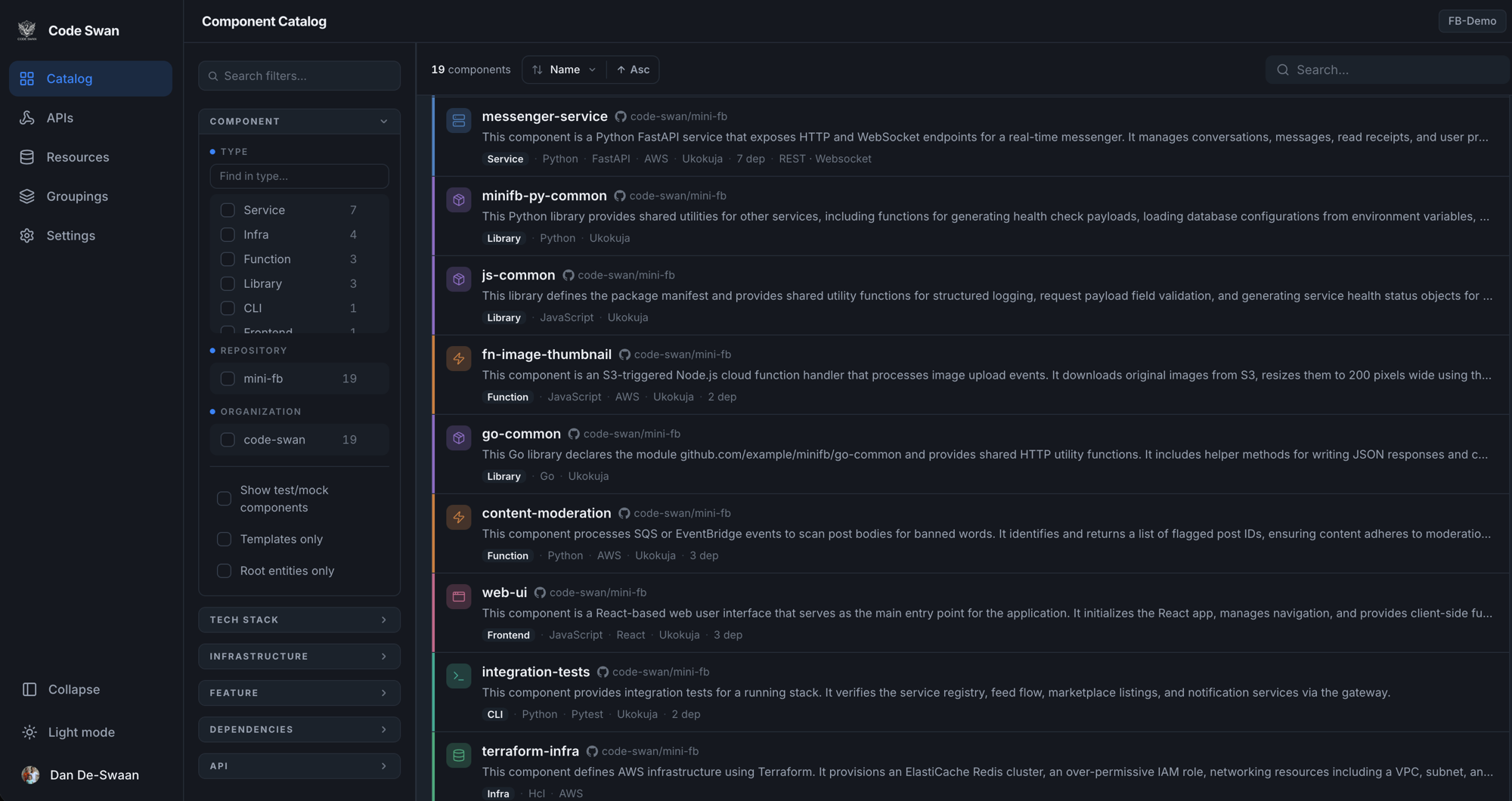
What Is a Living Software Catalog?
A living software catalog is a continuously updated, queryable record of every component in a software system, its services, APIs, cloud resources, owners, and business capabilities. Unlike a catalog maintained by hand, a living catalog is built directly from the codebase and stays accurate without any human maintenance effort.
Code Swan produces this catalog automatically on every scan. Every entry reflects the real, current state of your system, not the state it was in when someone last remembered to update the documentation.
The Problem With Manual Catalogs
Manual software catalogs require engineers to write entries, keep them updated, and remember to add new ones when things change. In practice, this means the catalog is accurate for about three months after it is built, and progressively wrong after that.
Illustrative scenario
An on-call engineer gets paged at 2am. They open the internal service catalog to find the owner of the failing service. The entry lists a team that was reorganized eight months ago. The Slack channel in the entry is archived. The runbook link is a 404. The catalog was never updated after the reorg because no one knew it was their responsibility to do so.
Teams stop trusting manual catalogs quickly. Once trust is gone, the catalog stops being used, and no one maintains something they don't use.
What the Catalog Contains
Every entry is derived from static analysis of your source code, not authored by hand.
Services
Every service in your system with its metadata, relationships, and status.
APIs & Contracts
Every endpoint exposed and consumed, including orphaned contracts.
Cloud Resources
Every database, queue, storage bucket, and event bus each service connects to.
Team Ownership
Who owns what, assigned directly from the codebase, not from a spreadsheet.
Business Domains
Which domain or product capability each service powers.
Dependencies
The full graph of service-to-service and service-to-infrastructure relationships.
How Teams Use It
Onboarding
New engineers explore the full system on day one, no need to ask colleagues what exists, who owns it, or how it connects.
Incident Response
When something breaks, ownership and dependencies are a single query away. No hunting through stale wikis under pressure.
Governance & Audits
Surface services with no owner, deprecated APIs still in use, and orphaned cloud resources, before they become problems.
AI Agent Context
The catalog is delivered to your AI tools via MCP. Agents answer engineering questions from the real, current state of your system.
Frequently Asked Questions
What is a living software catalog?
A living software catalog is a continuously updated, queryable record of every component in a software system, its services, APIs, cloud resources, owners, and business capabilities. Unlike a traditional catalog maintained by hand, a living catalog is built directly from the codebase and stays accurate without any human maintenance effort.
What information does the Code Swan catalog contain?
The catalog contains a record of every service in your system, its full API surface, the cloud resources it connects to, its team ownership, and the business domain it belongs to. Every entry is derived from static analysis of your source code, not from manually authored YAML or wiki pages.
How is this different from a traditional software catalog?
Traditional software catalogs require engineers to write and maintain entries manually. They go out of date the moment a service changes and teams stop trusting them within months. Code Swan's catalog is built from the codebase itself, there is no entry to write, no plugin to configure, and no entry that can drift from reality.
Who uses the catalog and for what?
Engineering managers use it for governance and to answer stakeholder questions. New engineers use it to orient themselves in an unfamiliar system. On-call engineers use it during incidents to trace ownership and dependencies quickly. AI coding assistants use it, via the Code Swan MCP server, to answer engineering questions grounded in the real system.
How do AI tools access the catalog?
Code Swan's MCP server exposes the full catalog as a set of queryable tools. AI coding assistants, Cursor, Claude, GitHub Copilot, and any MCP-compatible tool, can query it directly during a conversation. When an engineer asks their AI tool 'who owns the payments service?', the answer comes from the real catalog, not from training data.
Can the catalog surface governance issues automatically?
Yes. Because the catalog is built from code rather than manually maintained, it reflects the actual state of the system, including the things no one documented. Services with no owner, APIs with no known consumers, and cloud resources shared across teams without explicit acknowledgement all appear in the catalog as first-class entries.
A Catalog Your Team Will Actually Trust
Built from code. Always current. Zero maintenance overhead.