D Dana Claude Code
“Can I change the payments API?”
4 consumersorders-service, ledger-sync, accounting, fraud-detection
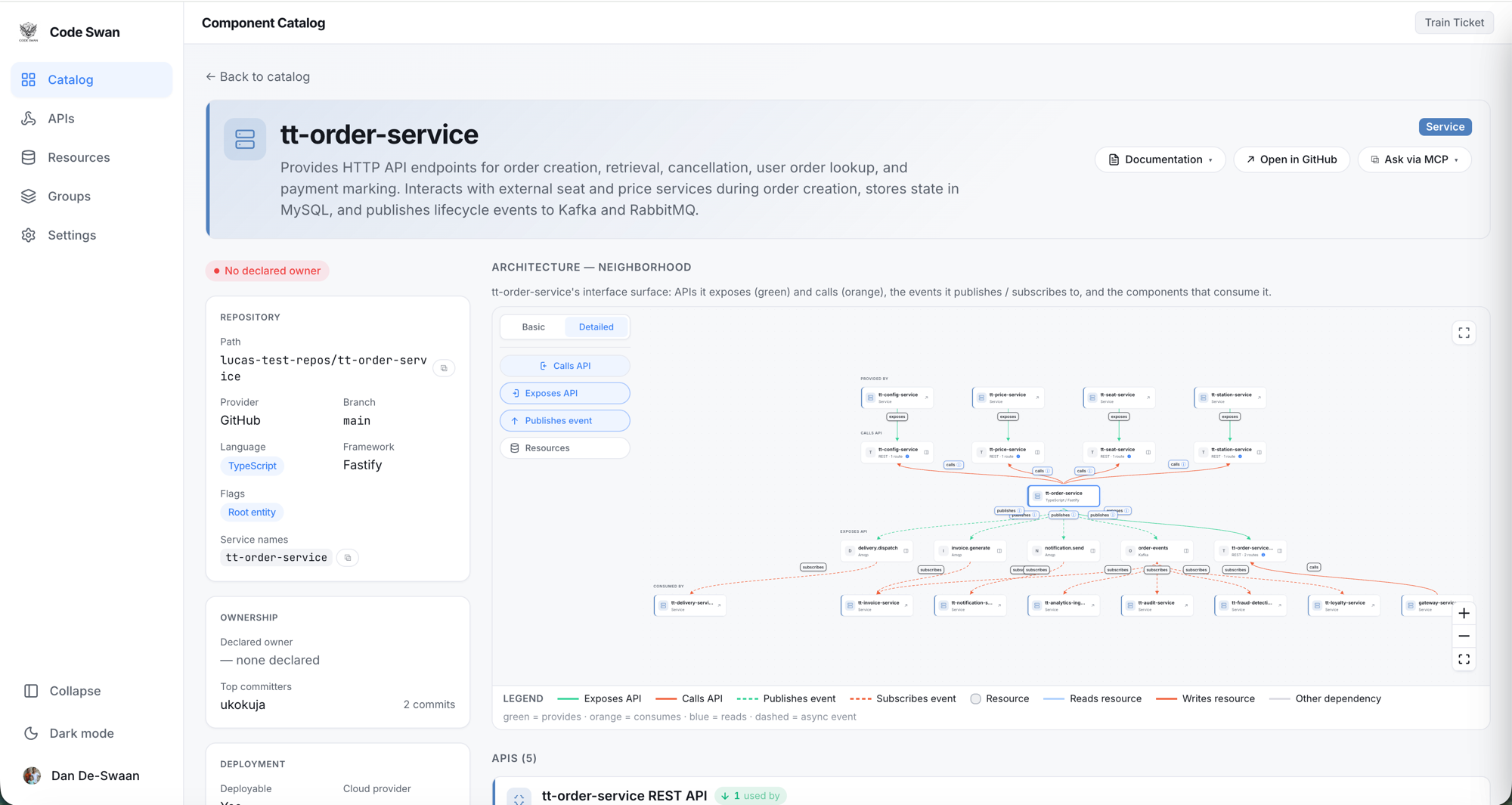
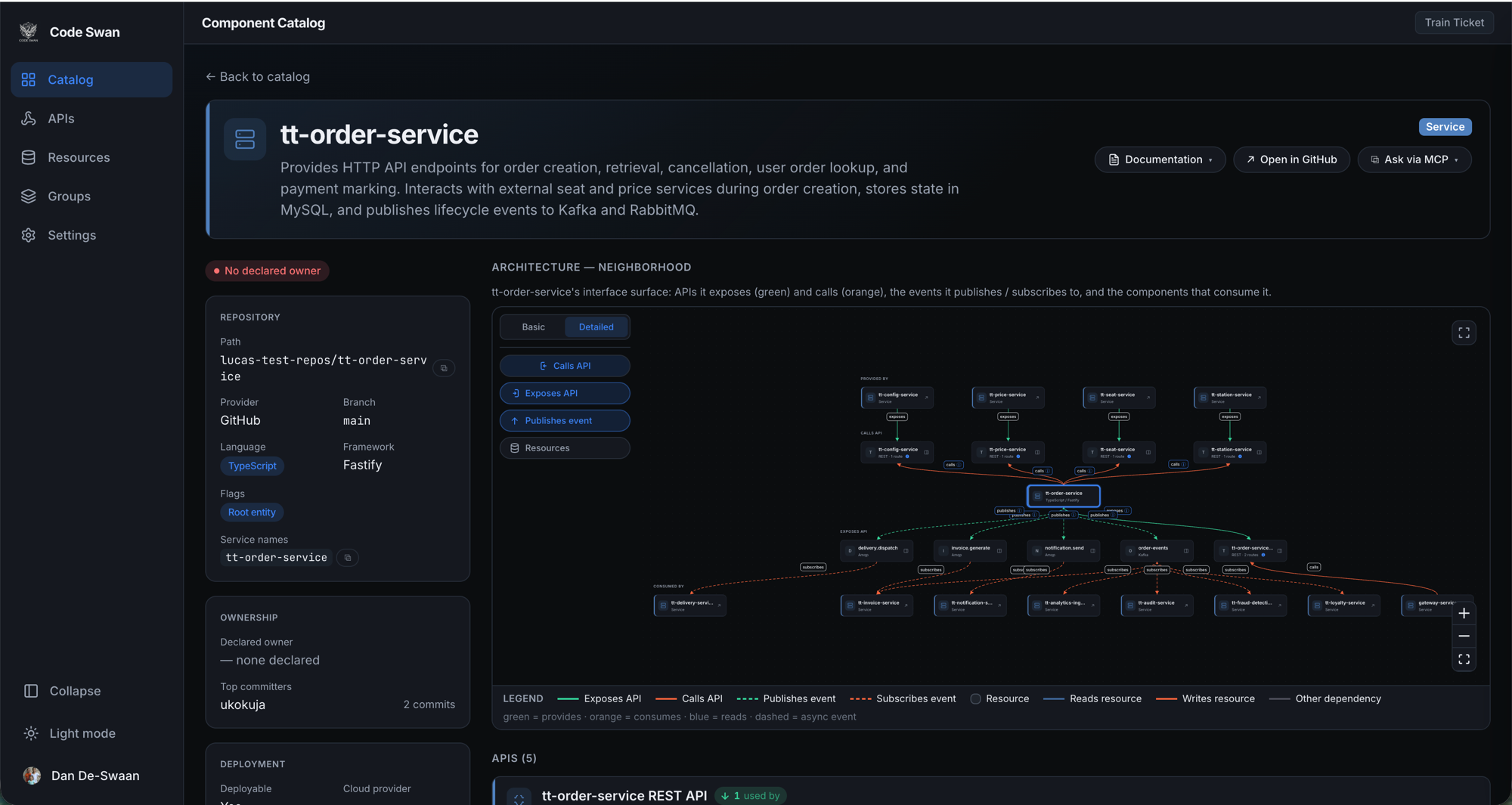
Code Swan feeds your AI tools a live map of your whole system, including architecture, APIs, ownership, and blast radius, so every change is grounded in how your code really works.
Measured across four frontier models and 3,300 scored answers. Read the benchmark →
Different people, different tools, different questions — every answer comes from the same living catalog.
“Can I change the payments API?”
“Do we already have rate limiting?”
“What does this change affect?”
“Who owns ledger-sync?”
“Which teams does checkout touch?”
“Who listens to order events?”
“Is this page still accurate?”
“What moves in this release?”
Everyone who asks — engineers, product, design, your CI, your docs — reads the same map.
Measured, not claimed
We asked four AI models twenty questions about one system of sixty repositories. Which services call which. Who reads each event. What stops working if a service goes down. Then we marked 3,300 answers against a key we wrote by hand.
40 → 8
wrong services named, per 100 answers
3.9×
more of the answer per token read
3,300
marked answers, four models
Read the full report Why assistants miss on large codebases →
Across the SDLC
One system map, delivered via MCP, so every stage — and every role — works from the same always-current picture.
Plan Product
Pressure-test ideas before a line is written
Skills you can run here, among others:
/find-reuse/feasibility-check/what-powers
Build Development
AI that fits your real system
Skills you can run here, among others:
/explain-component/blast-radius/find-api
Review Security
See the whole attack surface
Skills you can run here, among others:
/review-with-context/find-pii/boundary-check
Test QA
Test the risk that actually exists
Skills you can run here, among others:
/test-plan/flow-map/contract-check
Ship Management
A single, always-current source of truth
Skills you can run here, among others:
/who-owns/blast-radius/review-with-context
Support Customer Success
Scope issues without waiting on eng
Skills you can run here, among others:
/trace-feature/who-owns/component-docs
Plan for Product
Pressure-test ideas before a line is written
Skills you can run here, among others:
/find-reuse/feasibility-check/what-powers
Build for Development
AI that fits your real system
Skills you can run here, among others:
/explain-component/blast-radius/find-api
Review for Security
See the whole attack surface
Skills you can run here, among others:
/review-with-context/find-pii/boundary-check
Test for QA
Test the risk that actually exists
Skills you can run here, among others:
/test-plan/flow-map/contract-check
Ship for Management
A single, always-current source of truth
Skills you can run here, among others:
/who-owns/blast-radius/review-with-context
Support for Customer Success
Scope issues without waiting on eng
Skills you can run here, among others:
/trace-feature/who-owns/component-docs
Just a few of the highlights, the possibilities are endless.
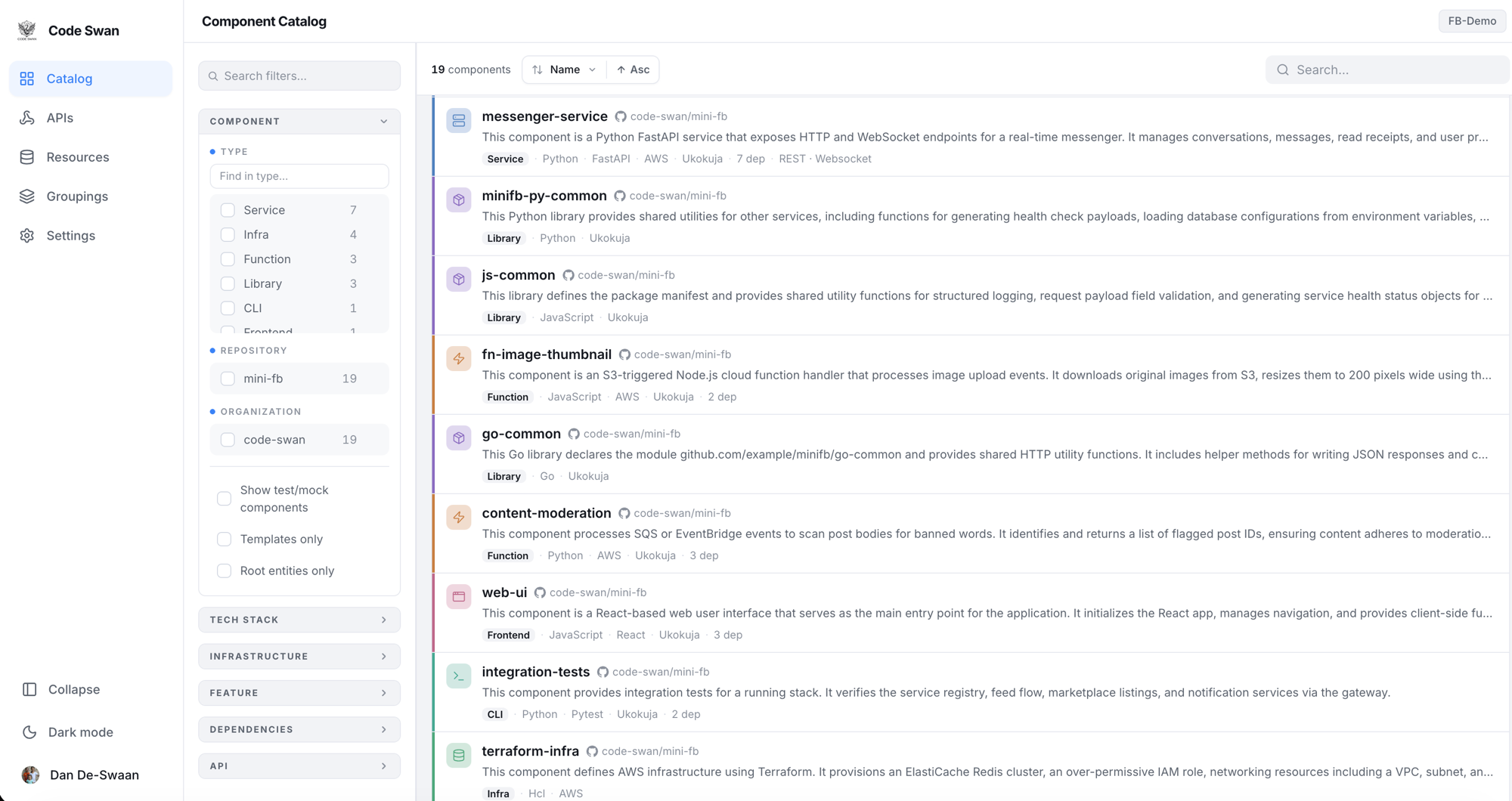
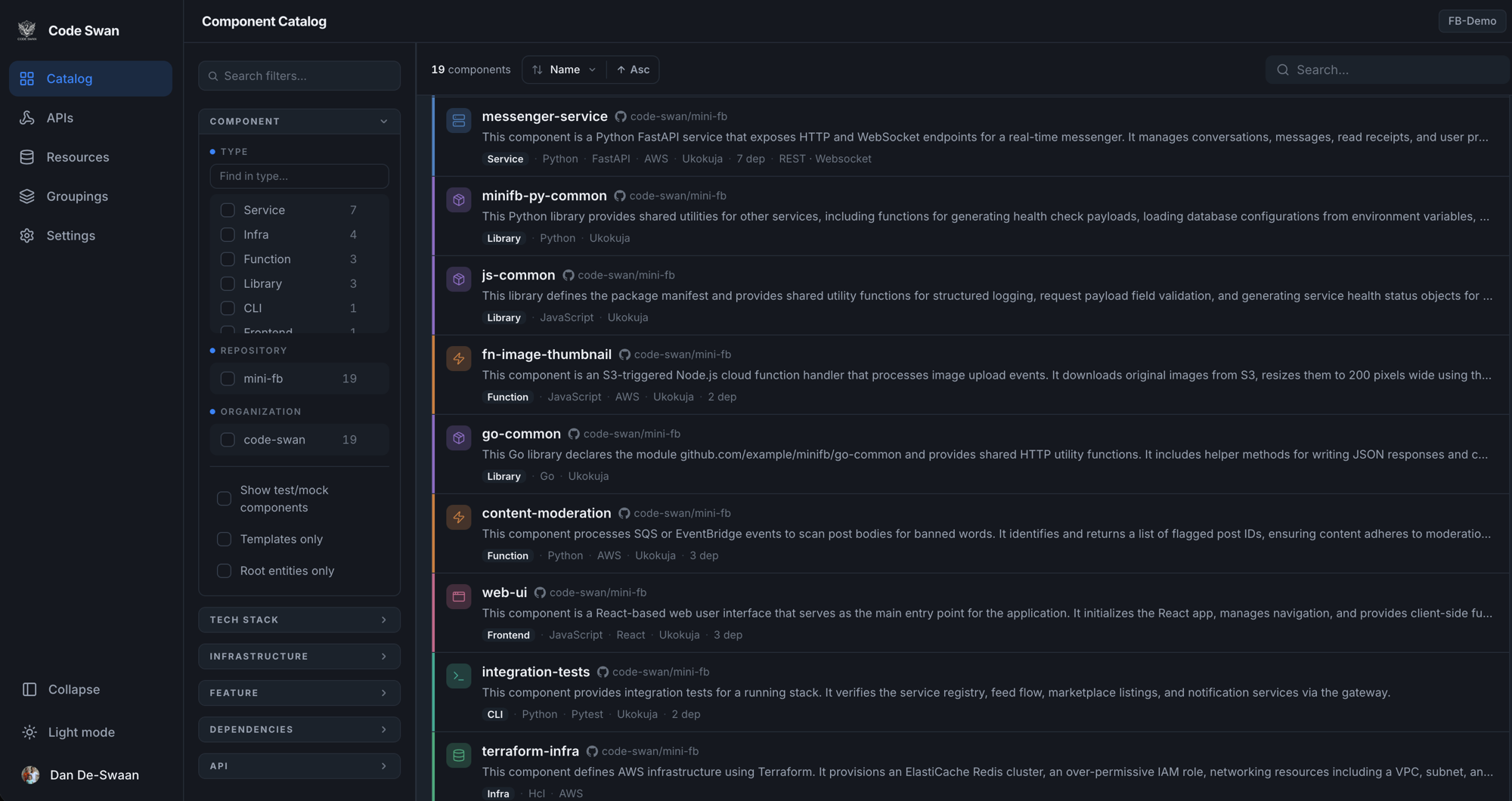
Living Software Catalog
A queryable record of every component in your system, built directly from your codebase and aggregated across GitHub, GitLab, and Bitbucket. Nothing to write by hand. Nothing that drifts from reality.
Explore more →Get started
Point Code Swan at your repos and watch your system become queryable by every agent on your team.
Book a demoRead-only access, five minutes of setup. The scan starts immediately.
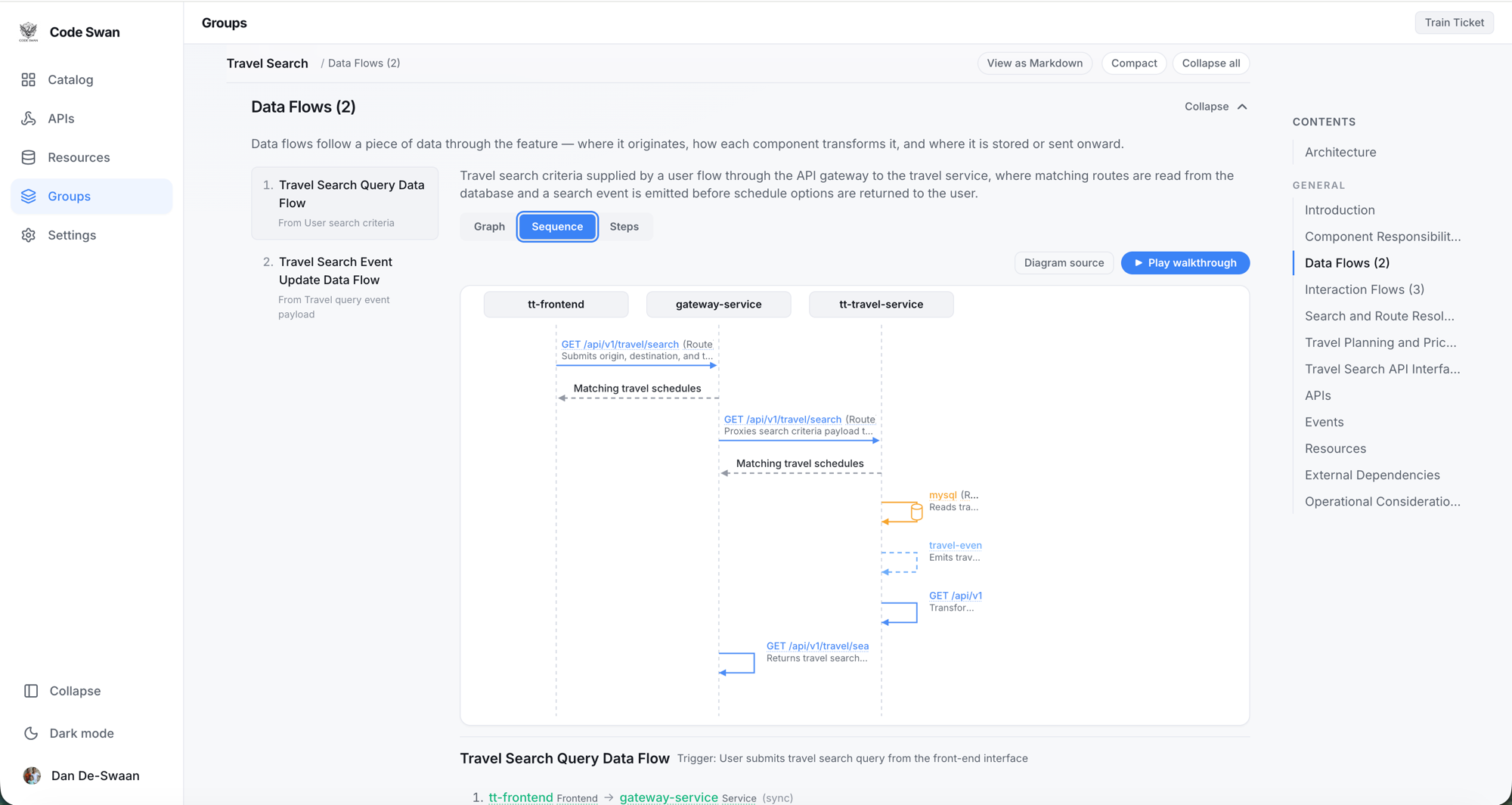
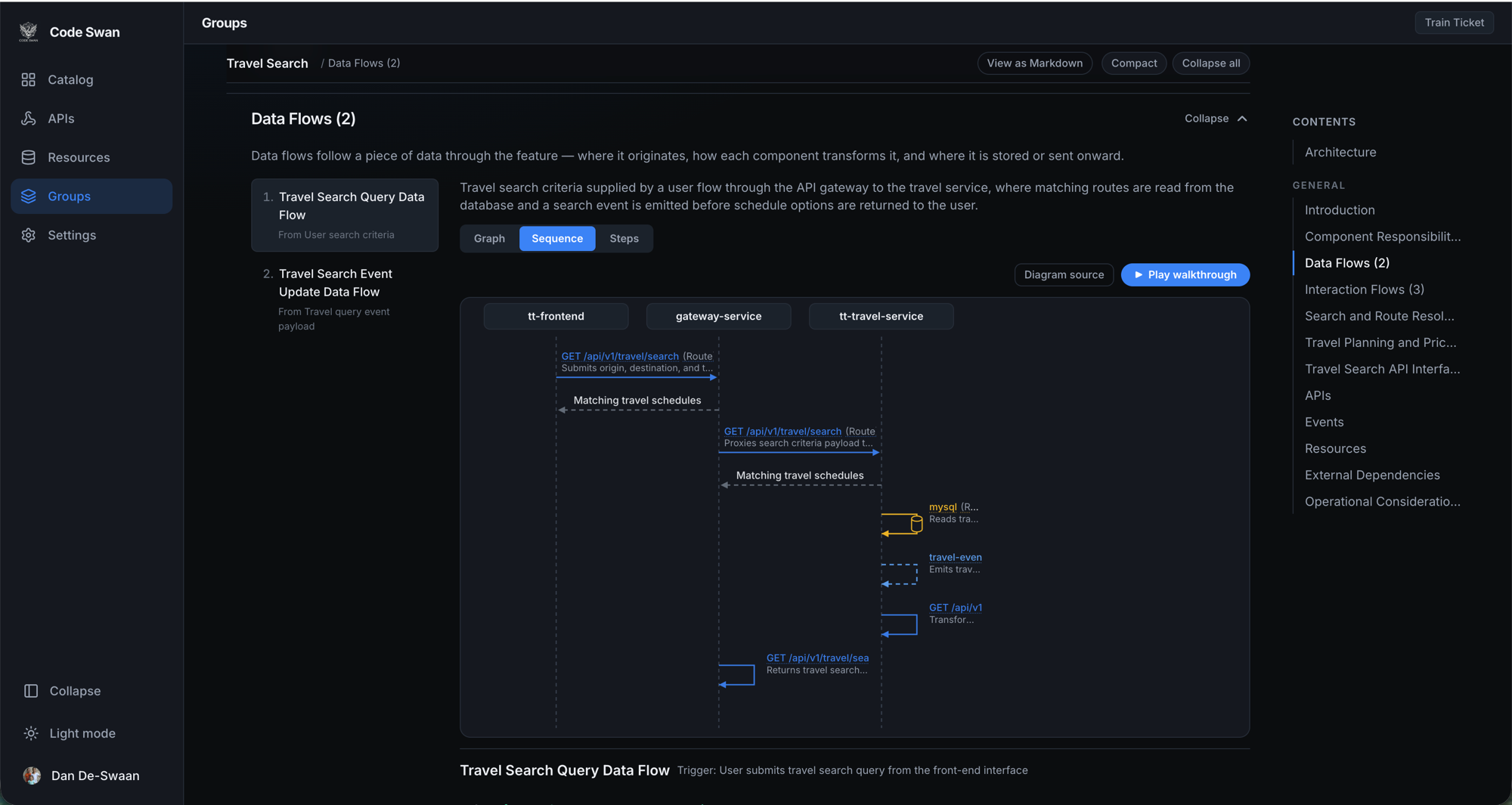
Services, APIs, owners and dependencies, mapped into a living graph.
Every AI tool on the team queries it via MCP — grounded answers, lower token spend.
Deployment
Deploy Code Swan on your own clusters, using your own LLM keys. Your source code and metadata never leave your network, the full product, in your environment, under your controls.
Questions & Answers
Common questions about context, MCP, and how Code Swan improves the accuracy of AI-assisted engineering.
AI coding assistants generate suggestions from their training data and the currently open file. They have no knowledge of your system's actual API surface, service dependencies, cloud resources, or architectural patterns, so they recommend deprecated APIs, miss cross-service dependencies, and duplicate code that already exists elsewhere in your codebase. The gap is not intelligence; it is context.
Why this gets worse on large codebases →An AI coding assistant needs structured knowledge of your system's APIs, which endpoints exist and who calls them, service dependencies, cloud resource connections, domain ownership, and architectural patterns. With this context, it gives suggestions that are correct for your specific system, not just syntactically valid in isolation.
MCP, the Model Context Protocol, is an open standard that connects AI coding assistants to external data sources. When connected to a codebase intelligence server, an MCP integration gives tools like Cursor, Claude, and GitHub Copilot structured knowledge about your system's APIs, architecture, and ownership, turning generic suggestions into system-aware ones.
About Code Swan's MCP server →Code Swan scans your source code to build a complete map of your APIs, cloud resource connections, service architecture, and domain ownership. This intelligence is exposed through a cloud-hosted MCP server. Engineers add the MCP server URL to their AI tool's settings, no code changes required, and their assistant immediately has full codebase context.
See how it works →Code Swan connects to GitHub, GitLab, and Bitbucket. You can connect multiple workspaces or organisations from each provider simultaneously, for example several GitHub organisations and a self-hosted GitLab instance at the same time. All repositories across every connected source are unified into a single observability layer, giving your team and their AI tools one consistent, accurate picture of the entire software landscape regardless of where the code lives.
An engineering intelligence platform automatically extracts and maps the structural characteristics of a software codebase, its APIs, service dependencies, cloud resource connections, and domain boundaries, and makes that intelligence available to engineering teams and their AI tools. It replaces manual documentation and outdated architecture diagrams with a live, queryable understanding of what the system actually does.
API Intelligence deep dive →Tell us about your codebase and we'll show you what Code Swan can uncover.
We use cookies to understand how visitors use our site. See our Privacy Policy for details.