Engineering Intelligence Boosts AI in Developer Platforms
Internal developer platforms give AI coding assistants like Cursor, GitHub Copilot, and Claude real context on your codebase's APIs, dependencies, and ownership, so they hallucinate less and suggest better code.
Internal developer platforms make AI coding assistants far more useful the moment they add a live engineering intelligence layer. That layer gives an agent real, current context about how a system’s APIs, dependencies, ownership, and architecture fit together. With it, agents stop guessing and start proposing changes that respect the real system. Without it, even a strong coding assistant works from a partial picture. On a large codebase it can only hold a narrow slice of the system in its context window, so it confidently hallucinates endpoints, imports, and services that were never there. Those suggestions cost more to review than they save.
Where internal developer platforms fall short with AI agents
An internal developer platform (IDP) gives engineers self-service access to environments, templates, and pipelines. Teams spend less time on setup and more time building, and for platform engineering groups the IDP is the obvious place to bring AI into daily work. The trouble starts as soon as an agent has to reason about the whole system rather than a single file. Most platforms surface documentation and a basic service catalog, and both drift out of date the moment the code moves on. An agent asked to add a feature or fix a bug then works from stale diagrams and generic descriptions. It hallucinates changes that cross service boundaries it cannot see, calls endpoints that have moved, and ignores the ownership rules teams depend on for review. Every one of those suggestions has to be caught and rewritten by hand, and after enough of them engineers stop trusting the agent for anything beyond trivial edits.
Context that matches the running code
What separates a helpful agent from a frustrating one is the quality of the codebase context behind it. Give an AI assistant an accurate, current picture of the system, meaning which services own which APIs, what depends on what, and who is responsible for each component, and its suggestions start to match how the system actually behaves rather than some tidy version that only lives in a wiki. That is what Code Swan brings to an IDP: a Living Software Catalog, a shared layer of code intelligence that tracks the real code. Ask which services call a given API, or which team has to approve a change to a shared library, and the answer reflects the system as it stands today.
Delivered through MCP, into the AI tools you already use
Context only helps if engineers can get it without leaving their workflow. Code Swan delivers its intelligence over the Model Context Protocol (MCP), the open standard that modern AI coding assistants already speak. Through a single MCP server connection, the same live view the platform uses for its own dashboards shows up right inside the tools your team already runs, from Cursor and GitHub Copilot to Claude. There is no second portal to check and no export to keep in sync. The connection is read-only and scoped to the task at hand, so an agent can ask about a service’s dependencies or the reach of a proposed change without ever getting write access to your code.
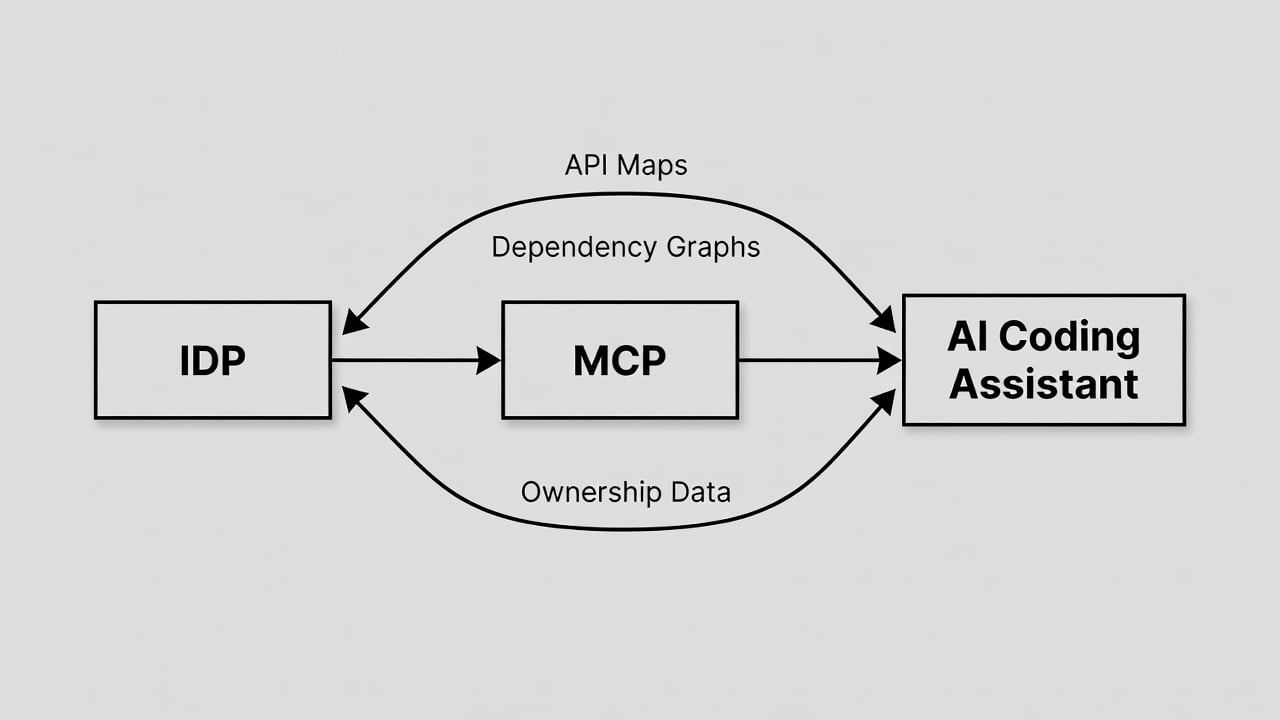 Diagram of data flow from codebase map through MCP to an AI coding assistant
Less coordination overhead, faster self-service
When an agent can answer questions about the system on its own, engineers spend far less time explaining context, both to their tools and to each other. A developer changing a payment service does not have to recall every downstream consumer or hunt for the team that owns the notification layer. The agent already has it. Questions that used to bounce around a team channel, like which services depend on this resource or who owns this component, get answered in the coding session instead. The platform turns into the one place where people and agents share the same accurate view, and reviewers can focus on whether a change is right instead of re-checking basic facts about the system.
Faster onboarding, consistent practice
New engineers get to useful work sooner when their AI assistant already knows the shape of the system. Rather than spending their first weeks piecing together service boundaries by hand, they can ask where the relevant code lives and how it connects, and get an answer grounded in the current system. Seasoned engineers feel it most on cross-team work, where an accurate impact summary saves hours of back and forth. And because every session starts from the same shared intelligence, the guidance stays consistent no matter who is asking.
Why static documentation falls short
Static service pages and architecture diagrams have their place, but they come with a standing tax: someone has to keep them current, and they rarely are. An AI agent that leans on them inherits every gap. Intelligence that stays tied to the running system takes that maintenance burden away, and it removes a whole category of AI mistakes and hallucinations that come from acting on stale information. When a change has to be reasoned across a chain of services, a living map can follow the chain. A static summary can only describe the intent.
The starting point for everything else
Give an internal developer platform a real engineering intelligence layer and its AI workflows change character. They go from generic autocomplete to context-aware changes that respect real system boundaries and ownership. An agent that understands the system is simply worth more than one that guesses at it.
This is the groundwork. Later posts will get into what it opens up: seeing the blast radius of a change before it merges, generating test plans that cover the surfaces a change really touches, and routing reviews to the right owners on their own. They all rest on the same starting point, which is giving your AI tools context they can trust. The practical next step is to watch it run against your own code.
Frequently asked questions
How is our code protected when AI coding assistants use this context?
Access to your repositories is read-only, and your code is never stored. It is scanned in memory, and only metadata about your system is kept. That metadata is never used to train models, and every tenant is isolated at the database level. Agents receive only the scoped context they need for the task in front of them.
Which AI coding tools can use this?
Any assistant that speaks MCP, the open Model Context Protocol, can connect, including Cursor, GitHub Copilot, and Claude. It gets the same structured view of APIs, architecture, and ownership that the platform uses internally, with no custom plugin required.
How is this different from adding a general knowledge agent to a developer portal?
A general knowledge agent answers from whatever documentation it was handed, which is usually static and often stale. An engineering intelligence layer gives the agent a live, queryable view of the real system, so it can reason about specific dependencies and ownership instead of paraphrasing a wiki.
Does the codebase context stay current as the system changes?
Yes. The map tracks the running system rather than hand-maintained documents, so the context an AI coding assistant works from reflects how things are now, not how they looked the last time someone updated a diagram.
Can the same engineering intelligence serve both human dashboards and AI agents?
Yes. The same catalog powers the dashboards engineers browse and the context agents pull through MCP, so people and tools always work from one consistent source.