Feature Flags: The Forks in Your Code Nobody Can See
Every feature flag is a fork in your codebase, and after launch nobody tracks what it switches, where it is read, or who it affects. Stale flags confuse engineers and AI coding assistants alike. Flag intelligence puts every flag on the map, with evidence.
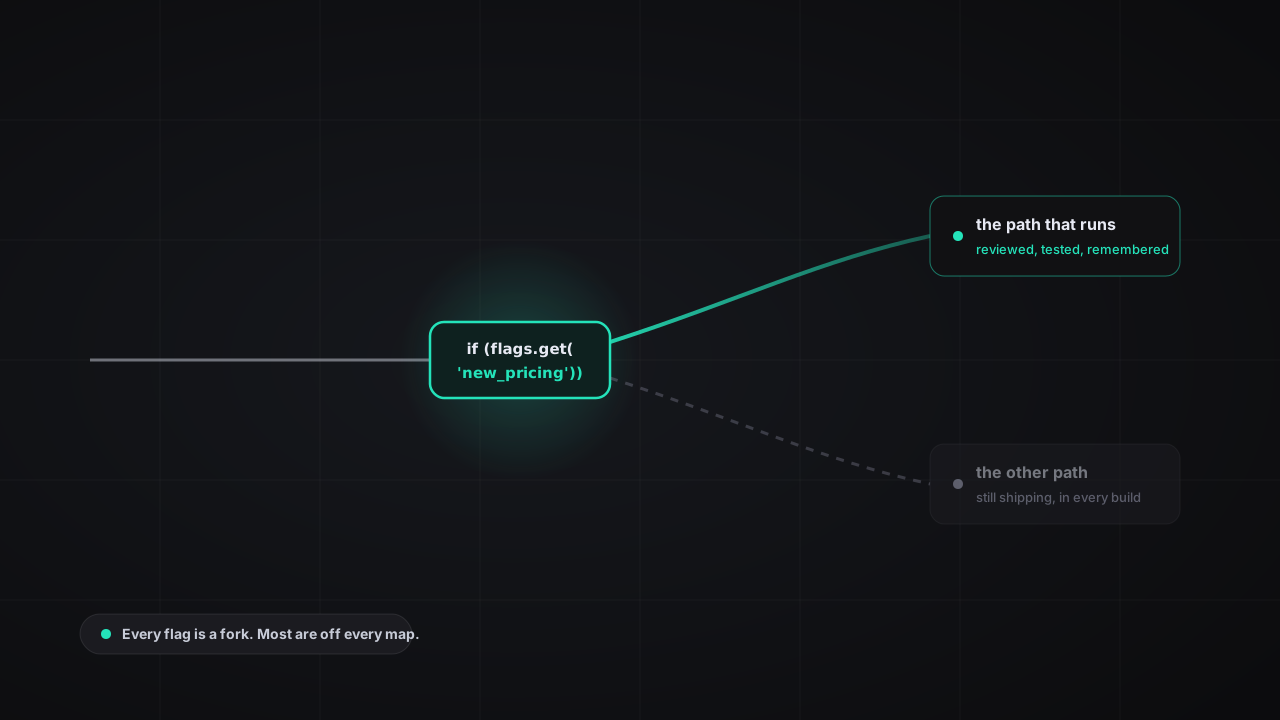
Feature flags are the fastest way to ship and the slowest thing to clean up. Every flag is a fork in your codebase: two paths, both shipping in every build, with a switch somewhere else deciding which one customers actually get. On launch day everyone knows what the flag does. Six months later the launch is old news, the author has moved teams, and the fork is still there, carried by people who never chose it and tested around by people who cannot explain it. Your flag provider can tell you which flags are on. Ask what any of them actually do, and the answer is somewhere in the code, waiting for someone to go dig.
Flag debt is a fork your team maintains forever
Teams talk about flag debt as clutter, but the real cost is sharper than that. Every lingering flag doubles a path through your system. Both sides have to keep compiling, both sides have to be considered in reviews, and both sides are candidates for the 2am question “which branch did this customer actually hit?” The classic support mystery, why does this work for every customer except one, is a flag question more often than anyone admits, and answering it means reading source for an afternoon.
Removing flags should be the fix, and it almost never happens, because removal needs confidence nobody has. Is anything still reading this flag? What exactly disappears if the old path goes? The person who knew left the knowledge in their head, so stale feature flags survive by default and the quarterly cleanup ticket rolls over, quarter after quarter. Not because anyone decided to keep the forks. Because nobody could prove it was safe to delete them.
Your AI assistant cannot see the fork
The last post in this series argued that your code is the only documentation you can trust. Flags are where that needs one more step. The code holds both sides of every fork, and to a reader without flag awareness, both sides look equally alive.
That reader is often an AI coding assistant. Give an assistant a file with a flag check in it and it has no idea one branch has been dark since last spring. It will propose a careful improvement to dead code. It will write a test plan that covers the path the author remembered and skip the fallback that only runs for ten percent of traffic. It will explain a flow as if the fork were not there, because nothing in its context says otherwise. The suggestions look polished, and they are reasoning about a system that is half imaginary.
Every flag, finally on the map
The fix is the same move this whole series keeps coming back to: derive the answer from the code instead of hoping someone remembers it. Code Swan’s flag intelligence records every flag your code reads and puts it on the same living map as your services and APIs: what each flag actually switches, with both sides described in plain terms, every place that reads it across all your components and repositories, and who it could affect, all the way down to the APIs and events behind it. Flags from your provider and your own homegrown helpers land in one inventory, and every statement comes with evidence from the code, so nothing is taken on faith.
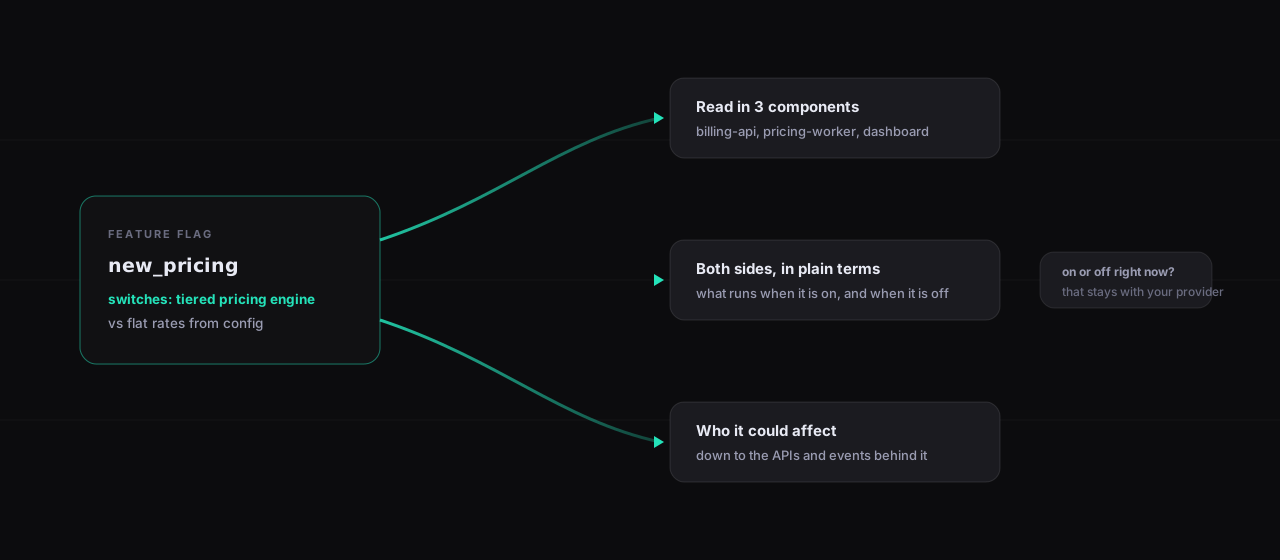 One flag, mapped: both sides in plain terms, every reader, and the reach behind it
The map and your flag provider cover two halves of the same picture. The provider owns the live state, which flags are on and for whom, and flag answers point you there for it. The map owns the code side, what each flag switches, where it is read, and who it could affect. The provider knows the switch. The map knows the fork.
Flag-aware answers, in the tools your team already uses
Because flags live in the same catalog your AI tools already query over MCP, flag questions stop being archaeology and become something you just ask, inside Cursor, GitHub Copilot, or Claude. What does this flag switch? Both code paths, with the evidence behind them. Which flags look ready to remove? Cleanup candidates, each with where it is still read and what disappears when it goes. Why does this behave differently for one customer? The flags on that path and what each side does.
The quieter win is everything the assistant already did, now done with flags in view. Reviews weigh both sides of a fork. Test plans cover the path that will run and the path that might. Flow explanations mention the branch point instead of walking past it. The assistant stops treating your codebase as one straight line, because it finally knows where the forks are.
Cleanup stops being archaeology
With the map in place, retiring flag debt turns from a research project into a checklist. Ask which flags look ready to remove, get candidates backed by evidence, verify the switch side against your provider, and delete with confidence. Each removal takes a fork out of your builds, a case out of your test matrix, and a trap out of your next incident. The codebase gets smaller in exactly the places nobody could prove were safe to touch before.
Flags were never the problem. Flags without a map were. If you are new to this series, start with why your code is the only documentation you can trust, or see the same idea applied to change safety in the blast radius of a change before you merge. Or point it at your own code and ask it the question every team has: which of our flags does anyone still need?
Frequently asked questions
What is feature flag debt?
Feature flag debt is the pile of flags that outlived their launch. Each one is a fork in the code that still ships in every build, still needs testing on both sides, and still trips people in incidents, long after everyone forgot what it was for. The debt is not the flag itself. It is every engineer who has to reconstruct what it does, one incident and review at a time.
Why are stale feature flags risky to remove?
Because removing a flag safely means knowing every place that reads it and what both sides do, and that knowledge usually left the team with whoever shipped the launch. So stale flags survive by default, the codebase carries forks nobody chose to keep, and the quarterly cleanup ticket rolls over untouched. With a map of what each flag switches and where it is read, cleanup candidates come with evidence instead of guesswork.
How do feature flags affect AI coding assistants?
An assistant that cannot see flags treats both sides of a fork as equally live code. It will propose edits to a branch that has been dark for a year, or write a test plan that covers only the path the author remembered. Flag-aware context tells the assistant a fork exists, what each side does, and who sits behind it, so reviews and test plans cover both paths.
How does this work alongside our feature flag provider?
The two cover different halves of the same picture. Your provider owns the live state: which flags are on, and for whom. Code Swan adds the code side: what each flag actually switches, where it is read, and who it could affect, with evidence from the source. Flag answers point you to your provider for the live state, so each tool is used for what it knows best.
Are homegrown flags covered, or only flags from a provider?
Both. Flags read through a provider and flags read through your own homegrown helpers land in the same inventory, so the one-off boolean that predates your flag platform is on the map next to everything else.
How is our source code protected?
Access to your repositories is read-only, and your code is never stored. It is scanned in memory, only metadata about your system is kept, and that metadata is never used to train models. Every tenant is isolated at the database level, and agents receive only the scoped context a task needs.