Why Your Code Is the Only Documentation You Can Trust
Wikis, architecture diagrams, and onboarding guides drift out of date the moment they are written, and many were never complete to begin with. Your code is the only source of truth that stays current, so documentation and AI context should be derived from it, not written about it.
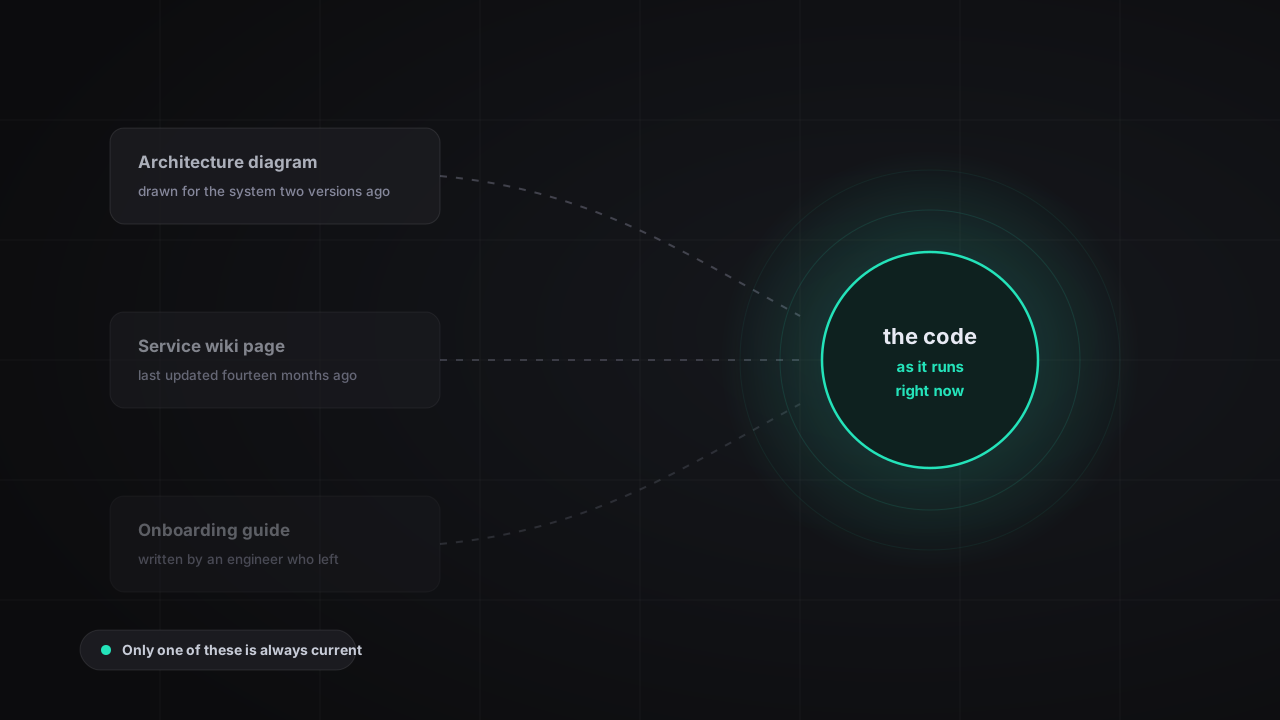
Every artifact that describes your software system is a snapshot, except one. The wiki page, the architecture diagram, the onboarding guide, the runbook: each of them captures what someone understood at the moment they wrote it. The code is different. The code is not a description of the system. It is the system. Whatever the question, the code already holds the current answer, while everything written about it has been aging since the day it was saved.
That gap has a name, documentation drift, and most teams underestimate it. We like to think of our documents as mostly right with a few stale corners. But drift only runs in one direction, and it never announces itself. A page does not look any different on the day it stops being true. The safer assumption is the uncomfortable one: every document about the system is out of date until proven otherwise, and the code is the only documentation you can trust.
Documents fail twice: they drift, and they were never complete
Stale documentation is the failure everyone knows. A service splits in two, an endpoint moves, a team hands over ownership, and the pages describing all of it stay as they were. Nobody goes back to fix them, because fixing documents is the task that always loses to shipping.
The second failure is quieter and starts earlier. A document was never the whole truth, even on the day it was published. The author wrote what they knew, at the level of detail they had time for, for the audience they had in mind. The diagram left out the background worker because it felt like noise. The wiki page described the happy path and skipped the queue that only matters during failures. So even a freshly written page gives you a partial system, and from there it only loses accuracy. Drift gets the blame, but incompleteness was there from the first day.
Who pays for stale knowledge
The cost lands at the worst moments. A new engineer follows the onboarding guide and builds a mental model of a system that stopped existing a year ago, then spends weeks quietly unlearning it. An on-call engineer at two in the morning follows a runbook that names a service that has since been replaced. A reviewer approves a change because the architecture diagram shows nothing downstream, and the diagram is simply behind.
AI coding assistants make the same mistake at much higher speed. An assistant cannot smell staleness. A page last touched fourteen months ago reads just as confidently as one from yesterday, so the assistant repeats it as fact. Feed your AI tools your wiki and you have automated the distribution of outdated documentation: hallucinated endpoints, phantom dependencies, and ownership that points at people who left. The assistant is not failing. It is faithfully reporting a source that stopped being true.
The code already holds every answer
The way out has been sitting in the repository all along: the questions those documents tried to answer are all answerable from the code itself. Which endpoints exist right now. Which services call them. What this component depends on, and what quietly depends on it. Where the system touches storage, queues, and outside providers. Who owns each part. None of that needs to be remembered or transcribed, because the codebase is the single source of truth for all of it, updated by every commit, with no separate editing step where the truth can slip away.
What has been missing is not the truth. It is the readable form of it. Raw code answers every question, but only to someone with time to dig, which is exactly what a new engineer, a reviewer in a hurry, or an AI agent in a coding session does not have.
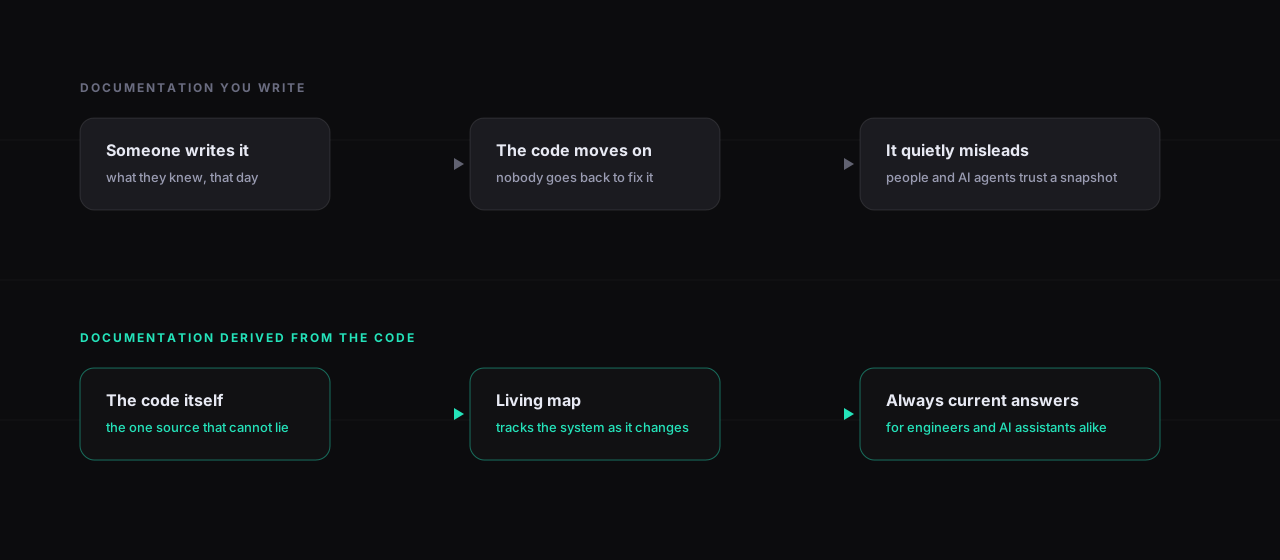 Documentation you write starts drifting at once. Documentation derived from the code has nothing to drift from.
Derive the documentation instead of writing it
This is the shift Code Swan is built around. Instead of writing documents about the code and hoping someone maintains them, the Living Software Catalog derives them from the code: a current catalog of your components, their APIs, their dependencies, and their owners, with architecture views that reflect the system as it stands today. When the code changes, the picture changes with it. There is no page to remember, no diagram to redraw, and no gap between what the team ships and what the documentation claims.
It also goes further than a parts list, because real work almost never lives inside one component. A task arrives as a feature: a flow that enters through one service, crosses two more, and lands in a queue somewhere. That is how the software development lifecycle actually runs, so the catalog gathers components into the groups the business recognizes, features, domains, and products, and keeps the design, the dataflows, and the architecture diagrams of each group current, along with the business context around it. Ask about the checkout flow and you get the flow: every component that takes part, how data moves between them, and what the feature is for. Not six separate service pages you have to stitch together yourself.
The same derived truth serves people and machines. Engineers browse it when they need to understand a service they have never touched. AI assistants query the very same view over MCP, so the context behind their suggestions is the running system rather than a snapshot of it. We covered what that does for assistants in giving AI coding assistants full codebase context automatically; the point here is deeper. Any answer that can be derived from the code should never be hand-written at all.
What still deserves an author
None of this makes writing obsolete. A document is still the only place that can hold intent: why the team chose this design, which trade-offs were on the table, what constraint shaped the strange part of the system. The code cannot say why it looks the way it does, and that is the part worth writing down.
What the code can say, let the code say. Decisions, context, and reasoning are written once and stay true, because the past does not change. Structure, endpoints, dependencies, and ownership are facts about the present, and the present changes daily, so they should be derived, never transcribed. Teams that make this split stop spending effort keeping documents alive and stop paying the much larger bill for the documents that quietly died.
When the diagram and the code disagree
Sooner or later a diagram, a wiki page, and the code will tell you three different things, and there is no real contest about which one is right. The code is the only witness that was present for every change. Build your documentation, your onboarding, and your AI context on top of it, and currency stops being something someone has to remember. If you want to see where that foundation leads, start with how engineering intelligence boosts AI in developer platforms, or see it catch real risk in the blast radius of a change before you merge. Or simply point it at your own code and ask it a question your wiki would answer wrong.
Frequently asked questions
What is documentation drift?
Documentation drift is the growing gap between what your documents say and what your system actually does. It starts the moment a page is written, because the code keeps changing while the page stays still. The document is not wrong on the day it is published. It becomes wrong quietly, over time, while everyone keeps trusting it.
Should teams stop writing documentation altogether?
No. Hand-written documents remain the best place for intent: why a decision was made, what trade-offs were weighed, what the team believed at the time. What should stop is hand-maintaining facts the code already holds, such as which endpoints exist, what depends on what, and who owns which component. Facts belong to the code. Intent belongs to the author.
How does outdated documentation affect AI coding assistants?
An AI assistant has no way to tell a current page from a stale one, so it repeats outdated documentation with full confidence. Feeding an assistant stale diagrams and wiki pages turns documentation drift into hallucinations about endpoints, dependencies, and ownership. Grounding it in the code itself removes that whole category of error.
What is living documentation?
Living documentation is documentation derived from the code rather than written about it. Because it tracks the real system, it reflects every change without anyone editing a page. The catalog, the diagrams, and the dependency views stay current because their source of truth is the codebase itself, not someone's memory of it.
Why do architecture diagrams go stale so quickly?
A diagram freezes one person's understanding at one moment, usually at a level of detail chosen for a single audience. The system keeps evolving, services split, dependencies shift, and the diagram stays exactly as drawn. Within a few quarters it describes a system that no longer exists, and it rarely covered the edges even on day one.
Does the derived context cover business features, or only individual components?
Both. Components are gathered into the features, domains, and products they serve, and each group carries its own design, dataflows, architecture diagrams, and business context. Engineers and AI assistants can ask questions at the level where real work happens, which is a flow through the system rather than a single service.
How is our source code protected?
Access to your repositories is read-only, and your code is never stored. It is scanned in memory, only metadata about your system is kept, and that metadata is never used to train models. Every tenant is isolated at the database level, and agents receive only the scoped context a task needs.